


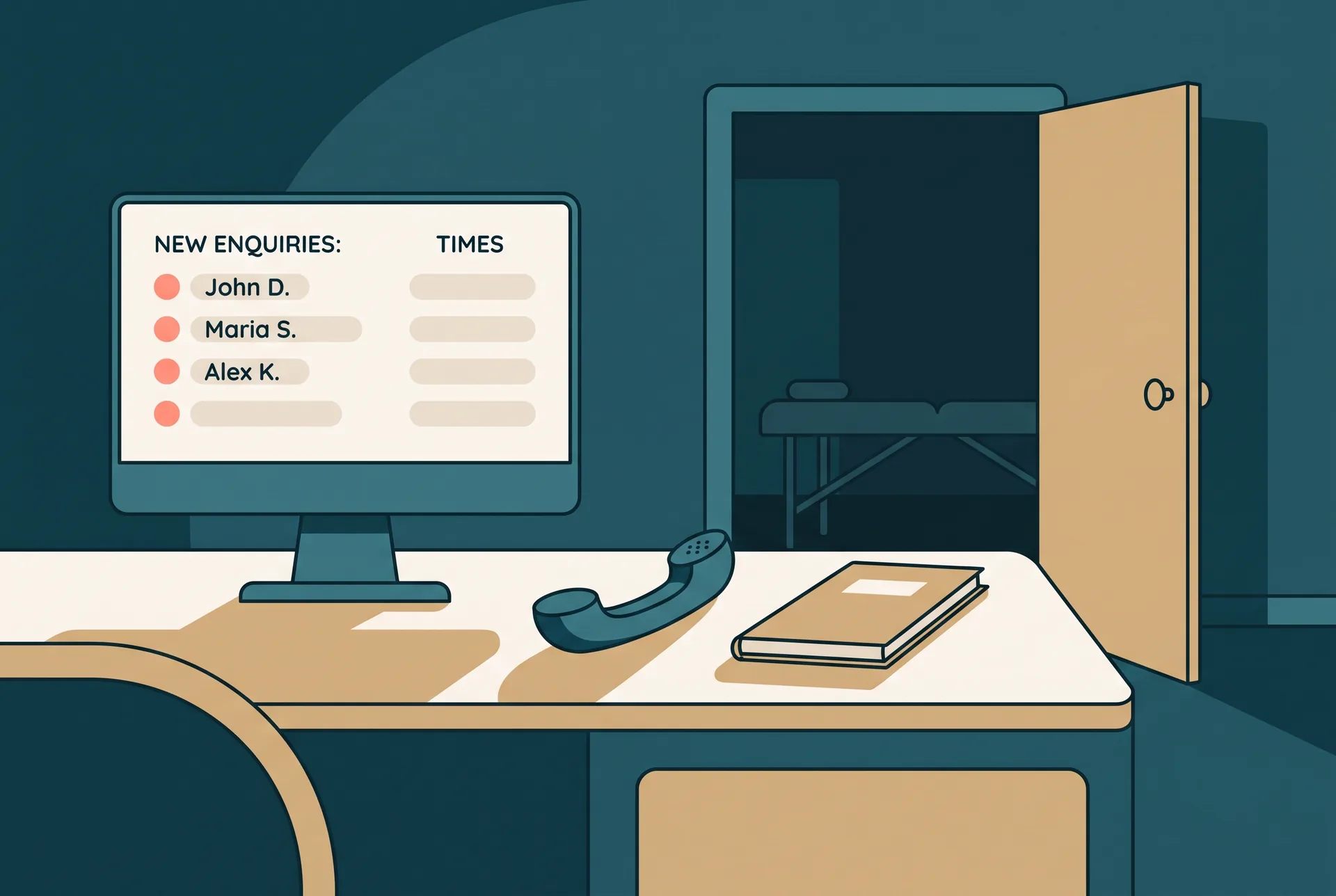
CRM meaning in a medical practice, in plain English
The CRM meaning medical practices actually need is not the one printed on a software company's home page. It is smaller, and more useful: the name for the place where a person who has written to you, and booked nothing, is kept.
This page stays on that question — what the three letters stand for, and where a new enquiry lives before the first visit. It does not compare products or categories of product: which system a clinic runs its day on is a separate piece of shopping, and it has its own page. No brand is named anywhere here.
What does CRM stand for in a medical practice?
CRM stands for customer relationship management, and in a clinic it is the place where a person who is not yet a patient is kept track of. In medicine the same three letters also belong to cardiac rhythm management, a different trade entirely, so the first thing worth settling is which of the two you are reading about.
The general definition is not in dispute. The encyclopaedia entry for customer relationship management calls it “a strategic process that organizations use to manage, analyze, and improve their interactions with customers”, and notes that CRM systems “compile data from a range of different communication channels, including a company's website, telephone, email, live chat, marketing materials, and more recently, social media”. Read that list again with a treatment room in mind and it stops sounding corporate: those are the places a new enquiry actually arrives.
The other meaning is worth naming once, because it explains why the search results for these words are so mixed. The published list of things the abbreviation CRM stands for includes cardiac rhythm management — “treatments of irregularities in the heartbeat” — a hospital-floor speciality with its own job titles and its own suppliers. Nothing on this page is about that. If you arrived here looking for it, this is the wrong page, and the fault is in the measurement rather than in your search.
Between the two, the way people phrase the question already tells you which answer they are after.
How clinics ask the question — measured monthly searches, United States
| The search people type | Monthly searches (US) | Difficulty (KD) | Cost per click (USD) | What they are really asking |
|---|---|---|---|---|
| crm meaning medical | 210 | 2 | not measured | What do these letters mean where I work? |
| crm medical meaning | 210 | not measured | not measured | The same question with the two words swapped round |
| crm medical term | 210 | not measured | not measured | Somebody who met the abbreviation in a clinical setting |
| crm definition medical | 210 | not measured | not measured | A definition wanted in one line, not a sales page |
| what does crm stand for in healthcare | 70 | 2 | 9.83 | The whole question spelled out, and the only row anybody is bidding on |
| crm meaning healthcare | 50 | 2 | not measured | The sector named instead of the profession |
| crm meaning in healthcare | 40 | 2 | not measured | The row above plus one preposition: one sentence answers both |
| what is crm in medical terms | 30 | 1 | not measured | The smallest row in the set, and the least contested phrase in it |
Three notes on that table. The figures come from a United States English data set, used as a declared proxy for the English-speaking market rather than as a world total, and the click price is in US dollars. An empty cell in the source is written “not measured” and has not been filled in with an estimate. And keyword difficulty is an estimate on a nought-to-a-hundred scale of how much established competition stands between a page and the first results without paying for the click; the wider price figures for the phrases around this cluster are already published on our own service page for clinic CRM, so they are not repeated here.
Read down the first column and it is one question typed eight ways. The spellings crm meaning medical and crm medical meaning are the same four words in two orders; crm medical term and crm definition medical ask it with a different noun; the healthcare pair differs by a single preposition. What is striking is the difficulty column: between 1 and 2, on a scale that runs to a hundred. Our reading is that the phrases are that open because the pages ranking for them are answering the corporate version of the question and leaving the clinical one alone.
Is a CRM the same thing as patient records?
No: patient records describe someone who is already a patient, and a CRM describes someone who has only made contact. They answer two different questions about two different moments.
The official definition of the clinical record is specific about what belongs in it. An electronic health record is described as “a digital version of a patient's paper chart”, holding “demographic data, medical history and diagnoses, including past illnesses, surgeries, and medications, progress notes, test results, and vital signs, treatment plans, immunizations, allergies, and prescriptions, radiology images, and insurance and billing information”.
Every item on that list presumes a relationship that has already started. Somebody who sent a message on Sunday evening has no history, no diagnosis and no vital signs — they have a question and a telephone number, and there is no column for them anywhere in that record. The crm medical term is for exactly that person, and the boundary is a functional one: the two systems describe two stages of the same human being. Where the legal line falls between them is a matter for the rules of your own country, and it is not a question this page answers.
What does a CRM do that a diary does not?
A diary holds the appointments that exist; a CRM holds the enquiries that have not become appointments yet. One is a record of the past, the other is a queue of the future.
A diary can tell you that Thursday at four is free. It cannot tell you that three people asked about Thursday, that two of them are still waiting for an answer, and that one of them wrote eleven days ago and has had eleven days to find somebody else.
The definition quoted above gives the mechanism plainly: a CRM compiles what arrived by web form, by telephone, by email and by message into one place, so that the thread belongs to the practice rather than to whichever device happened to receive it. In a two-room studio that is the entire point. An enquiry that came in on a personal phone during a treatment is, until somebody writes it down, a fact known to exactly one person.
Where does a new enquiry live before it becomes an appointment?
Somewhere between a form, a phone and a memory — and that is exactly the gap where enquiries are lost. Naming that place is most of what a CRM is for.
The gap has a shape. A message arrives while the practitioner's hands are on somebody; it is read between patients and not answered, because answering it properly takes four minutes and there are two; by the evening it is one of nine things; by Thursday it is gone. Nothing broke. There was simply no place the enquiry belonged to between arriving and becoming an appointment.
Type crm patients into a search box and that is the question being asked in two words: who is holding the person, rather than the booking. The commercial half of the answer — somebody to hold it, and somewhere to hold it — is set out on our page about crm for medical clinics. Search crm therapists and you will find both halves mixed together: some of the people typing it want to know what the thing is, and some already want somebody to run one for them. This page is the first half.
Emanuele De Falco, a physiotherapist, describes the far end of that gap closing. What he has published in his own words, on our partners' reviews page, is this: “The schedule is full; I don't know where to put the new patients, expectations exceeded by 200%. The system you provide, beyond the advertising, manages everything automatically, and this is spectacular.” That is one practice's experience, published as his own words; it is not a result anybody can promise in advance.
Does a single-therapist practice need one?
It needs the function, not necessarily a product: someone or something has to hold the contact while the therapist is treating. A solo practice is the case where the gap is widest, because there is nobody else in the room.
In a practice with somebody at the desk, the function exists whether or not it has a name: the person at the desk is the CRM, and the pad beside the telephone is the database. In a one-room practice there is no desk and no second person, so the function has to live somewhere else — and where it ends up, when nothing has been set up, is memory.
So the question is not really whether to buy something. It is what happens at four in the afternoon, and there are three honest answers: a person who is not treating, a system that replies, or nothing. The third is a decision too, and it is the one nobody writes down. A virtual receptionist for clinics is the first of those three made explicit.
Two practitioners who started out on their own have published what that felt like. Camilla Bettarello, a nurse in private practice and an osteopath, writes: “I recommend Med-Wave to all professionals who need to start their practice like I did or who want to consolidate it to avoid physiologically slower periods.” Valerio Tomassetti, an osteopath, puts the mechanism more bluntly: “I didn't have to talk to anyone, and I found patients in the office. I recommend it to anyone who wants to open their own practice or work independently.” Both are individual experiences, published in their own words.
What should a clinic ask before choosing one?
Ask what happens to an enquiry that arrives at nine in the evening, and who is accountable when nobody replies. The answer to those two questions decides more than any feature list.
Both are questions about people rather than features, which is why a comparison page is not where you will find them. A demonstration will show you the pipeline view, the tags and the automated sequence. None of that tells you who reads a reply before it goes out, or what the system does when somebody asks something the form did not anticipate.
The neighbouring question — which system runs the clinic day to day, as opposed to which one holds the enquiry — is a different piece of shopping, and we have written it up separately under practice management software for therapists. Keeping the two apart is what stops a shortlist turning into a feature list.
Veronica Zamboni, an osteopath, has published this about the automatic side of it: “Of all the methods and portals, this is the only one that brings new patients in no time. Such results are not normal; automatic management of the schedule thanks to Artificial Intelligence has allowed me to focus solely on the patients in the office.” In the same video interview, spoken in Italian and reported here rather than quoted, she also says that the automatic replies were not always precise, and that she went in and corrected them herself.
That second half is the more useful one for anybody choosing a system, and it turns into a third question worth asking: not whether the replies are automatic, but whether you can read them and change them.
And if the answer to the first question is that the enquiry waits on a phone until the evening, no product on any shortlist fixes that by itself. Somebody has to be responsible for the reply. If you would rather that somebody were not you, you can Apply as a customer.


