

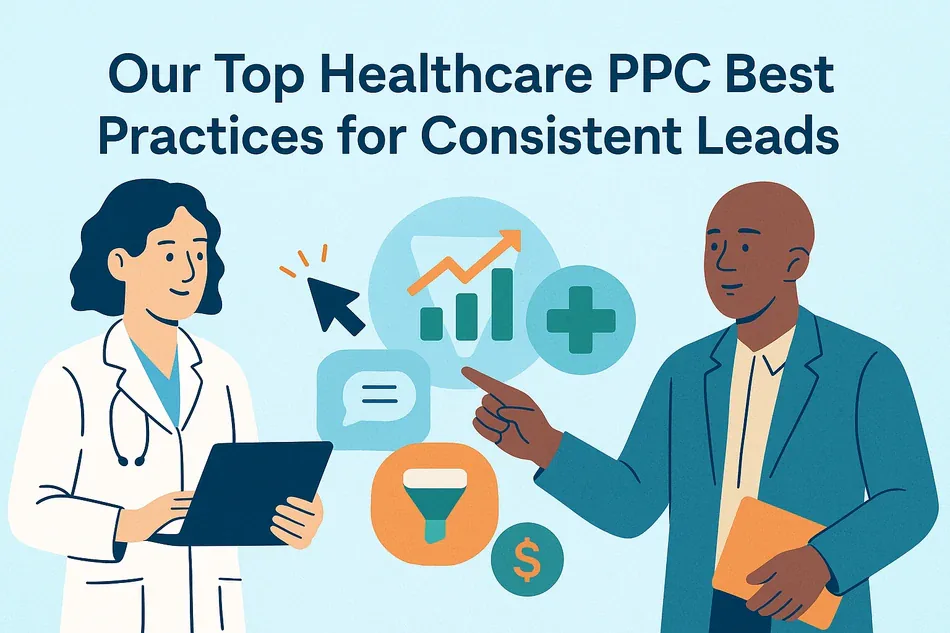
Our Top Healthcare PPC Best Practices for Consistent Leads
Recognize healthcare PPC potential
Healthcare PPC best practices form the backbone of consistent and predictable patient acquisition in today’s competitive landscape.
As independent healthcare providers (such as dietitians, chiropractors, physiotherapists, or dentists), you often seek effective and automated ways to attract new patients without the burden of extensive manual marketing. PPC advertising, especially on platforms like Google and Microsoft Ads, enables you to target individuals searching for your specific services, creating immediate visibility. In fact, studies show healthcare PPC can yield an average return of $3 for every $1 spent, as reported by WordStream. By focusing on precise keywords, compelling ad copy, and relevant landing pages, you significantly enhance your chances of consistently drawing in high-intent leads.
Nevertheless, not all campaigns achieve these outcomes.
Many factors, including compliance restrictions and fierce competition, can hinder your results. As a result, a well-rounded approach that includes paid campaigns, nurturing tactics, and performance monitoring is vital. Our experience indicates that a properly integrated PPC strategy, specifically designed for healthcare and wellness professionals, reduces wasted ad spend and drives sustainable growth. For more detailed insights, you may consult our guide on healthcare ppc campaigns.
Focus on compliance issues
Navigating compliance is paramount for healthcare advertising. Each advertising platform imposes strict guidelines on what can be advertised, how personal data is handled, and which claims can be made. Violating these rules can result in suspended accounts or heavy penalties, effectively cutting off your main pipeline of new patients. We recommend reviewing platform policies in detail and staying informed about any certification requirements or prohibited content, as outlined in our healthcare advertising compliance resource.
Furthermore, country-specific regulations may require additional verifications or limit certain types of retargeting. The key is to align your ad wording and targeting parameters with guidelines that emphasize transparency and truthfulness. By prioritizing policy compliance, you build trust among patients, differentiate your practice, and mitigate the risk of sudden account shutdowns that can disrupt critical patient-acquisition flows.
Optimize ads and keywords
High-quality ad copy and carefully selected keywords lie at the heart of any successful PPC campaign. When someone searches for “back pain treatment near me” or “nutritionist for sports performance,” your ad must appear at precisely the right moment with precisely the right message. Our expertise indicates you should:
- Build ad groups around patient-specific needs. For instance, consider segmenting your campaigns for preventive care, pain management, or wellness support.
- Use concise yet compelling ad text to address the searcher’s intent directly. Incorporate patient-friendly language that is both accurate and reassuring.
- Employ relevant negative keywords to avoid clicks from irrelevant searches. This approach preserves your budget for higher-quality leads.
- Maintain consistency between ad copy and landing page content to improve Quality Score and reduce cost-per-click.
To stay organized, consider keyword-planning tools like SEMrush or Google Ads Keyword Planner, which can reveal valuable search terms for your region and professional niche. As you refine these terms, watch for shifts in search volume or seasonal spikes (such as sports-related injuries or special holiday promotions) to keep your ads well-aligned with patient demand.
Design high-conversion pages
Once prospective patients click on your ad, they must be directed to a landing page that swiftly meets their expectations and encourages them to take the next step. According to our analysis, well-designed PPC landing pages typically feature:
- A concise and relevant headline echoing the ad’s promise.
- Clear presentation of benefits, such as exceptional expertise or state-of-the-art treatments.
- An easy-to-use contact form or booking widget, making it simple to schedule an appointment.
- Trust markers like certifications, patient testimonials, or professional association badges.
Typically, 350-500 words of carefully curated content is optimal for PPC landing pages, as it supplies enough information to build credibility without overwhelming the visitor. Since provider visibility often hinges on user experience, a mobile-responsive format is also essential. By pairing persuasive copy with intuitive design, practices can notably raise their conversion rates and limit wasted ad spend.
Use geofencing and location
Location-based marketing is a powerful way to connect with individuals in your immediate area. Through geofencing, you can deliver targeted mobile ads to people who enter a defined radius around your practice or relevant community spaces. Research suggests geofencing campaigns can cost anywhere from $5 to $15 per thousand impressions, but the return can be substantial when precisely aimed at local prospects.
Moreover, leveraging Google Ads’ location extensions ensures your address appears directly in your ad, simplifying the path to on-site visits. For healthcare practitioners offering localized services such as physical therapy or laser-eye surgery, these features reduce friction for prospective patients searching “physical therapy near me” or “laser vision correction in [city].” When executed well, location-focused tactics become catalysts for increased foot traffic, especially for urgent or same-day needs. We invite you to discover more location-targeting guidance in our healthcare advertising targeting resource.
Monitor metrics and performance
Data tracking stands as the bridge between guesswork and reliable growth. By consistently reviewing metrics like click-through rate (CTR), cost-per-click (CPC), conversion rate, and cost-per-acquisition, you can pinpoint which campaigns drive meaningful results for your practice. The average CTR for healthcare and wellness ads sits at around 3.27%, but your target may vary based on your services and local competition.
We advise integrating tools such as Google Analytics and specialized dashboards to monitor patient flows, measure ad spend effectiveness, and confirm that your return on investment remains on track. KPI reviews also help identify areas where additional budgets or strategic adjustments can have the most impact. We discuss additional ways to elevate advertising ROI in our healthcare advertising analytics guidelines.
Consider the complete ecosystem
Nevertheless, PPC alone rarely solves the entire patient acquisition challenge. Our expertise indicates that a comprehensive marketing and management ecosystem delivers far superior results compared to isolated ad campaigns. At Med-Wave, we handle every step of the process, from social media content to AI-based appointment scheduling. This approach allows you to stay fully focused on patient care while we manage a robust platform that improves patient retention, fosters positive reviews, and scales your practice sustainably. Our fully integrated solution includes:
- Three weekly Facebook posts and three weekly Instagram posts, ensuring visibility while avoiding duplicate or “scammy” agencies’ tactics
- Well-targeted paid ads that drive a continuous stream of high-intent patients
- A proven CRM with automated lead nurturing campaigns, developed through hundreds of thousands of test leads
- AI-driven scheduling via WhatsApp, iMessage, or SMS, ensuring patient follow-up with minimal staff effort
- A conversion-driven website fully integrated with booking systems
- Patient reactivation strategies that maximize lifetime value and encourage referrals over time
Within a short setup period, these components begin to pay for themselves, generating compounding profitability. By continually reinvesting in consistent advertising, many partners expand rapidly, often adding new locations as appointment bookings rise.
Sum up next steps
We recommend forming a PPC strategy that aligns with compliance requirements, uses precise ad targeting, and connects prospective patients to high-conversion landing pages. Nonetheless, the true key to sustainable success in healthcare marketing involves implementing a complete model that pairs PPC with marketing automation and patient engagement systems. As a result, you can control your monthly costs, track your ROI, and unlock consistent growth without splitting focus between treating patients and marketing your practice.
Our expertise indicates that a carefully designed, fully managed ecosystem is the surest path to predictable leads and ongoing profitability. If you are ready to elevate your practice and benefit from an integrated solution, we invite you to apply as a partner through our dedicated form: https://www.med-wave.it/en/apply-as-a-customer
By allowing us to manage your complete acquisition process, you can direct your energy toward exceptional patient treatments, assured that your marketing engine runs seamlessly in the background.


